




You're not behind.You're running an operating model that no longer works.

Somewhere in your first year back from maternity leave, the adrenaline runs out. You're still trying to work the way you did before kids, but you can't operate that way anymore. The old model worked for the life you had then. It doesn't work for the life you have now. That's not losing your edge. It's a sign that the model needs to change.

Allie Williams at home, holding a mug.

This is The Wall.

It tends to hit 6–12 months after you return. Everyone prepares for birth and the logistics of returning to work. Nobody plans for what happens once the adrenaline wears off.

You're still performing well. It simply costs more than it used to.
You are busy from the first minute to the last, and still end the day feeling invisible.
You overcompensate on availability, then quietly resent the standard you set.
Your calendar looks exactly like it did before leave. Your life does not.
You assume everyone else has figured out something you missed.
And you've decided, without quite saying it, that the struggle is yours to carry alone.

This is The Wall. You don't get through it by pushing harder, which can lead to burnout. You get through it by changing how you operate.

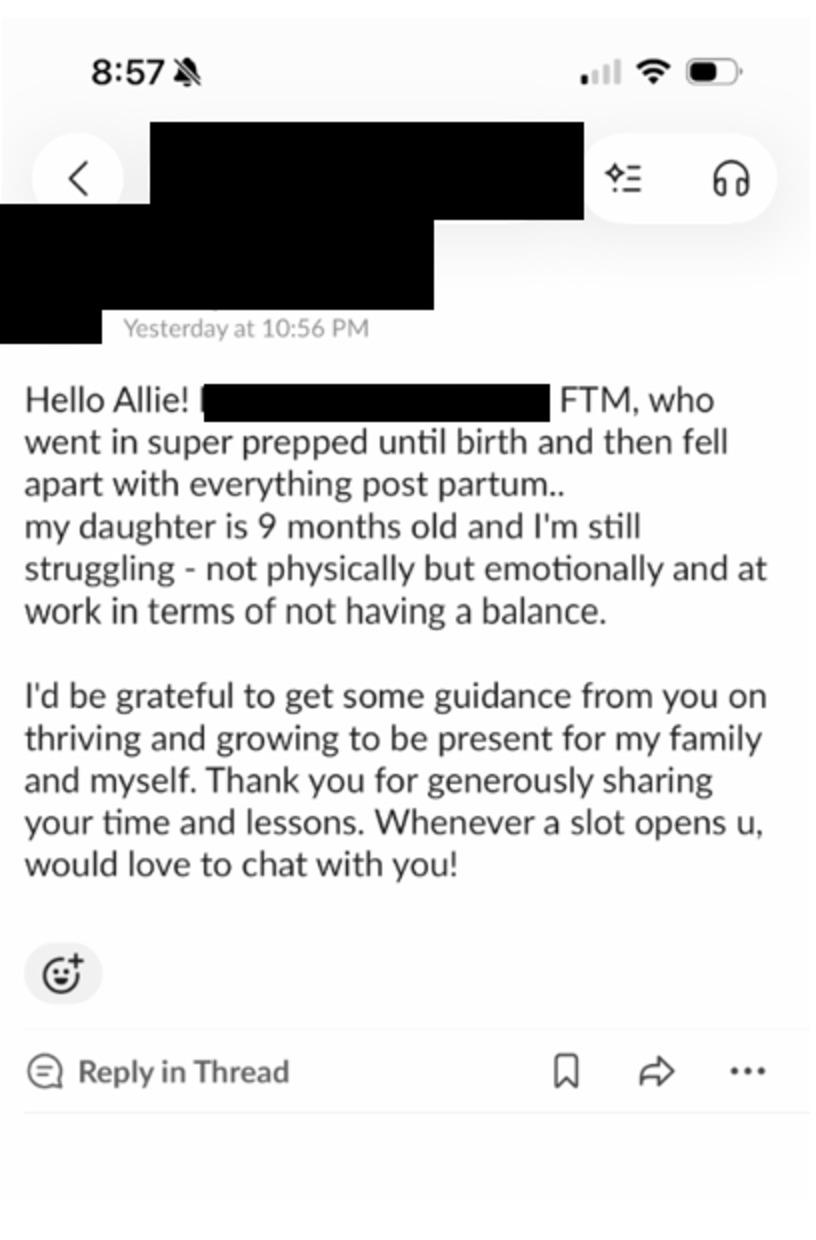
Message from a reader describing falling apart after birth and still struggling nine months on.

I kept hearing the same thing.

I've coached women navigating their return to work for over five years, and I've heard from hundreds of women going through the same transition. Different jobs, different companies, different circumstances. But the same patterns keep showing up: they prepared for birth, leave, and the logistics of going back. They weren't prepared for what happened once the adrenaline wore off and this became their new normal.

You don't come back the same.
You come back differently.

It isn't a capability problem. It's an operating model mismatch.

You are good at your job and you know it. You didn't forget how to do your job while you were gone. What changed is that the model underneath your work (more hours, more availability, more being everywhere) no longer works with the life you have now.

Running a model that no longer fits is what builds The Wall. But the constraints aren't all downside. Having less time forced me to get much clearer about where I was actually useful. I make decisions much faster now. I say no to things I would have said yes to before. I'm less interested in being 100% available, 100% of the time — because I simply can't be. With each leave, I came back better. And not because I put in more hours. I got better because I changed how I worked.

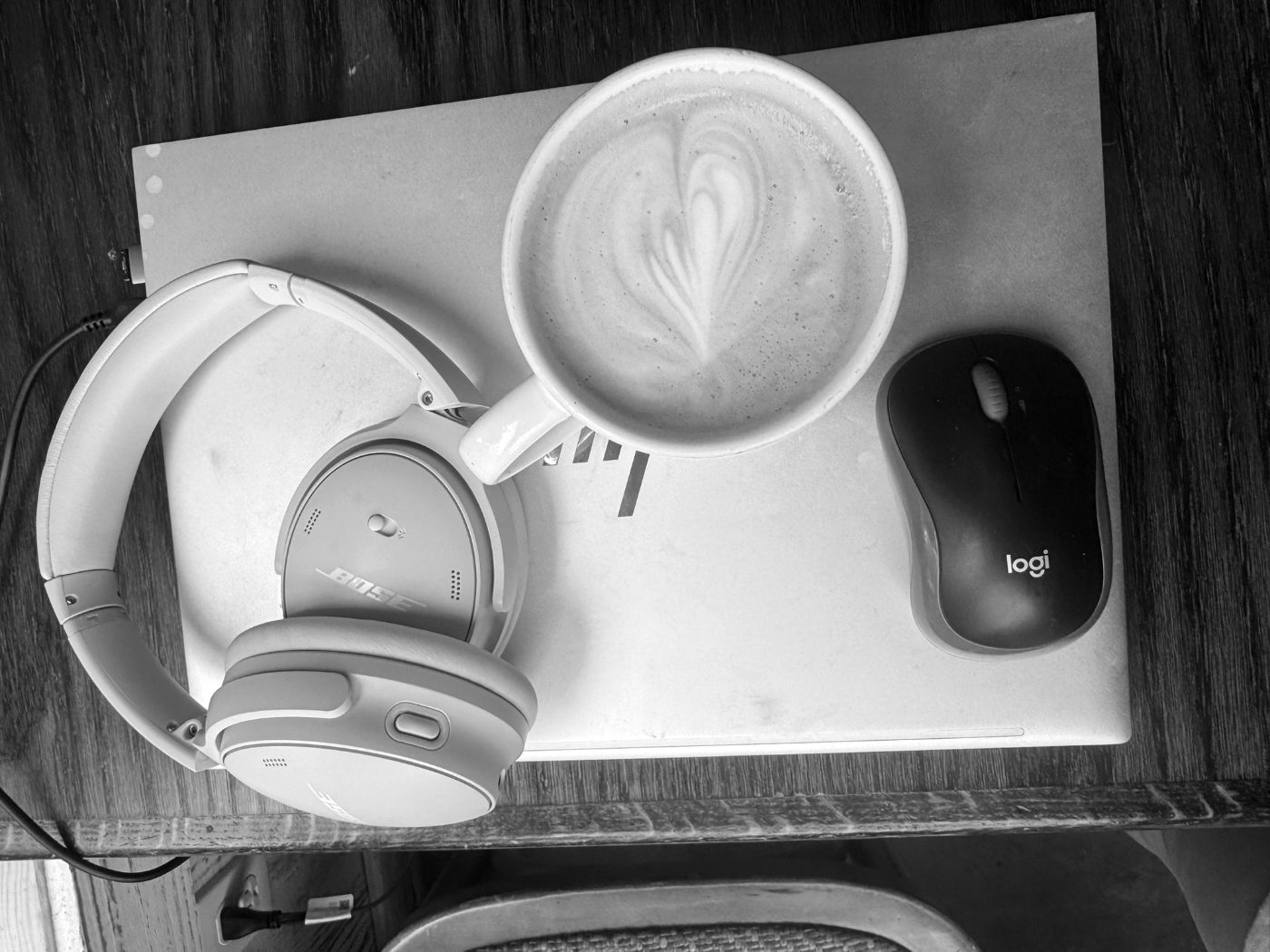
A laptop, headphones and a latte on a desk.
A ferry crossing toward the Seattle skyline under heavy cloud.

The four pillars of The Recalibrated Return.

The Recalibrated Return is built around four pillars. Think of the pillars as a loop, because you'll want to constantly evaluate them as your life evolves. Your role changes. Your kids change. Your constraints change. You need a way to recognize when the model stops working and recalibrate it.

Notice01

See how you're actually operating.

Start with what you're actually doing. Where are you saying yes automatically? Where are you over-preparing, over-owning, or staying available because that's what has always worked? Before you change anything, you need to see what you're actually doing.

What am I doing automatically — and what's driving it?

Defaults are still decisions.

Inspect02

Understand what sits underneath the behaviour.

Work backward from the behaviour to the rule underneath it. If you're answering messages immediately, for example, what do you believe would happen if you didn't? Then ask whether that rule is actually required by your job or whether you've been carrying it forward because it worked before.

Does this rule still hold — or am I operating from evidence that no longer fits?

Proven doesn't mean permanent.

Rewrite03

Decide how you want to operate instead.

Once you can see the rule, you get to decide whether you still want to run it. Some standards stay. Some need to change. The important part is making that choice deliberately — including being honest about the tradeoff.

What changes? What stays? What does it cost?

Every standard has a tradeoff.

Reality04

Make it work in your actual life.

A new rule is easy to write down. The question is whether it still works when the deadline moves, your kid is sick, your team needs you, and the old way would be easier. If it doesn't hold, figure out why. Adjust it and run the loop again.

What did the tradeoff really cost — and what needs to exist around me so this doesn't run on willpower?

If it only works on a good week, it doesn't work.

Then you run it again. Your work changes. Your kids change. Your scope changes. The point isn't to build the perfect operating model. It's to know how to recalibrate when the one you have stops working.

A Washington State ferry crossing open water with Mount Rainier behind it.
A coffee mug on a windowsill, trees outside.
The Seattle skyline at dusk seen from the water.

I built this across three maternity leaves in big tech, with myself as the first proof of concept.


Three returns, each one into more scope than the last. And three very different versions of figuring out how to make work “work” again.

First return
Promoted — and hit The Wall.On paper, the return was going well. In reality, the way I'd always worked wasn't holding anymore. This was when I knew something had to change — and when I started rewiring how I worked.
Second return
Two kids. A smoother return.I moved from a non-technical to a technical role, but somehow the return itself was easier than the first. The difference wasn't that life had become less complicated. I'd already started changing how I operated.
Third return
Three kids. More scope.I stepped into my boss's role, leading product, program, analytics and engineering. Home was more chaotic. Work was bigger. I kept changing how I operated instead of expecting myself to work the way I had before kids.
The cohort
Launched the Founding Cohort in August 2026 and filled all 10 spots.A four-week cohort to identify the operating rules that no longer work, rewrite them, and build a model that holds in real life.

Across 15+ years, I've led and partnered across product, engineering, finance, operations, HR, program, brands, customer service and PR, including global teams and worldwide rollouts.

Allie Williams on the morning ferry, holding a coffee.

I'm Allie Williams. Senior leader in big tech, mom of three kids under five, and founder of The Recalibrated Return.

I'm not interested in telling women to lower the bar, lean out, or care less about their careers. But I also don't believe your career should be all-consuming. I'm a big believer in work-life separation, not work-life balance (which I believe is a total scam). My career supports the life I want for my family; my family shouldn't have to absorb the pressure of my career. I've spent years in high-stress roles learning how to make that separation real, because my kids should never have to feel the pressure of my job.
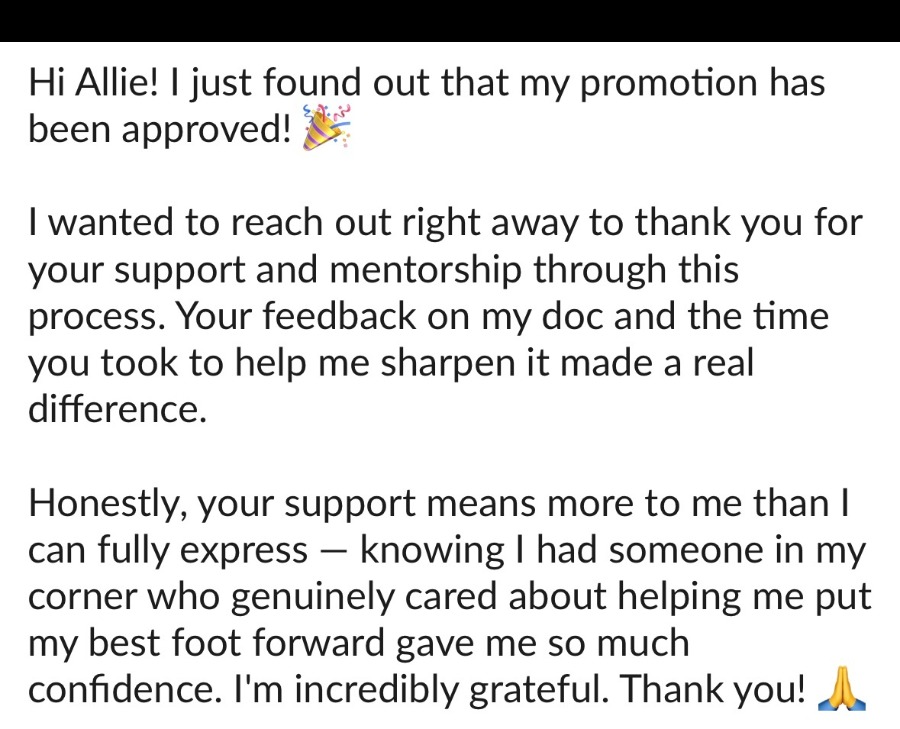

What women have told me.

Messages from women I've coached, mentored, and worked with. Names removed.

Message about a promotion being approved, thanking Allie for support and mentorship through the process.
Promotion approved
Message: the top 3 to-do list suggestion worked, tried over the weekend and at work.
Putting the Top 3 into practice
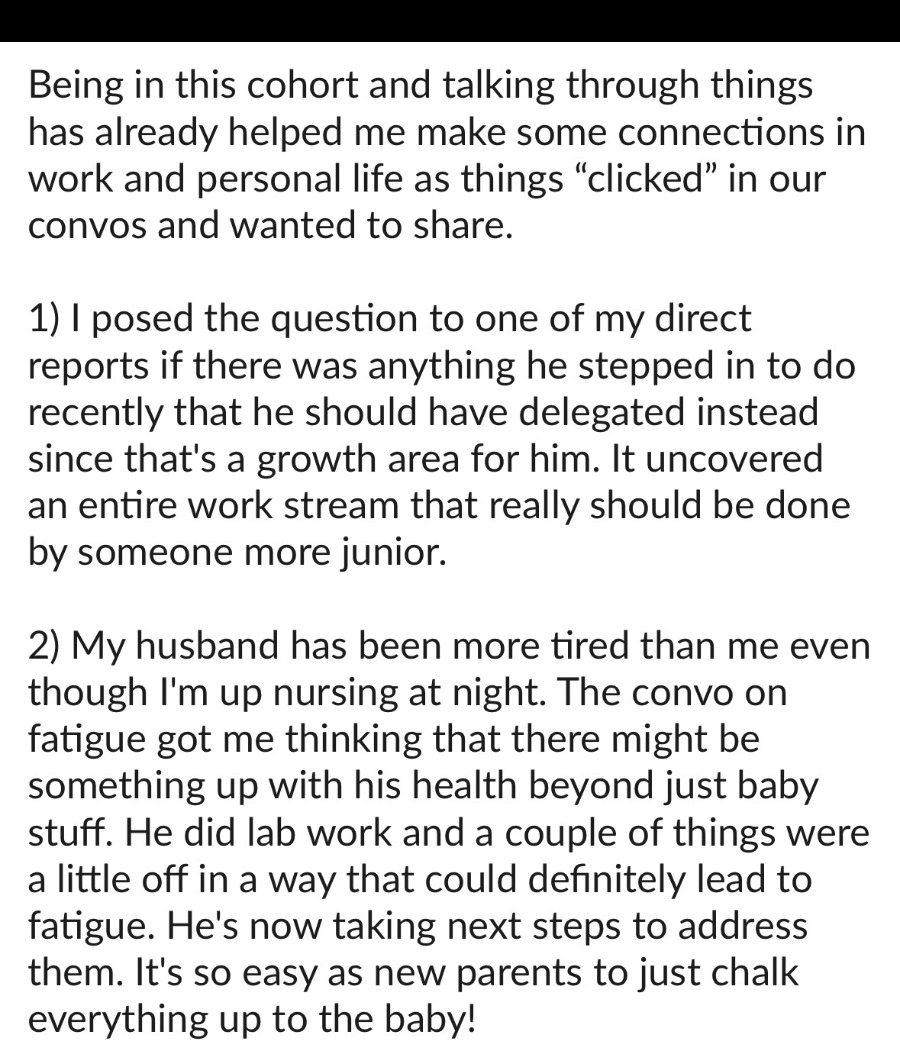
Message from a cohort participant describing two specific changes at work and at home.
Founding cohort participant
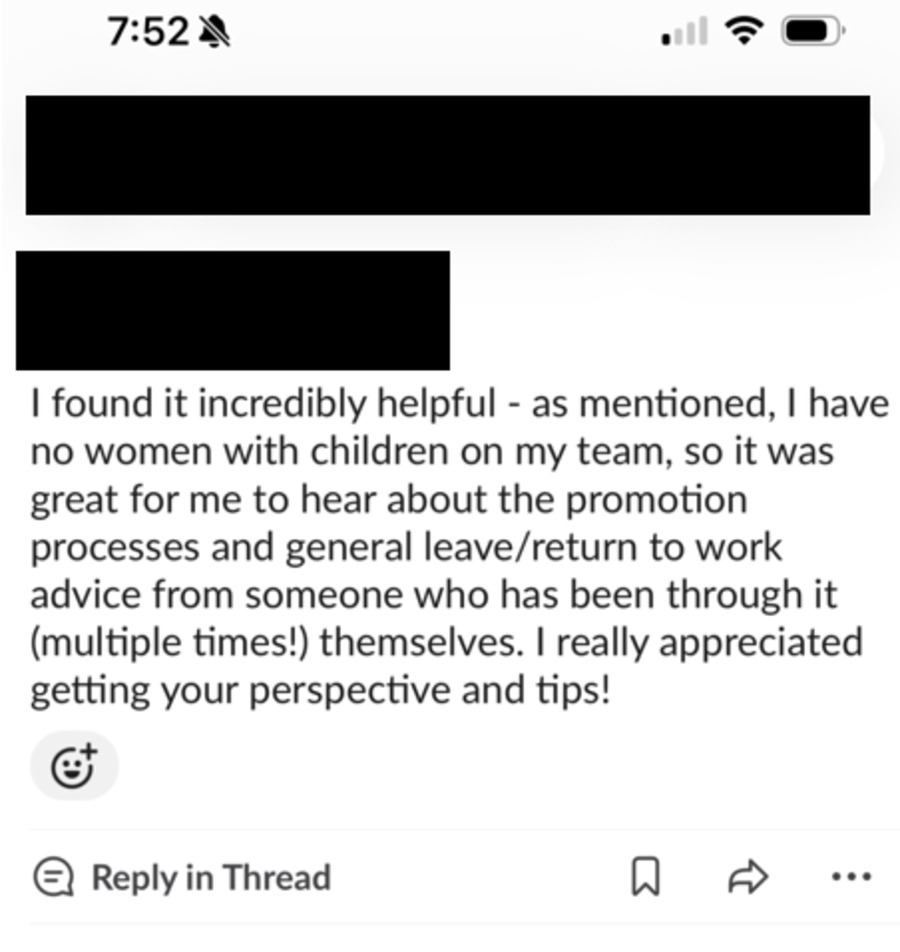
Message on the value of hearing promotion and return-to-work advice from someone who has been through it multiple times.
On why lived experience mattered
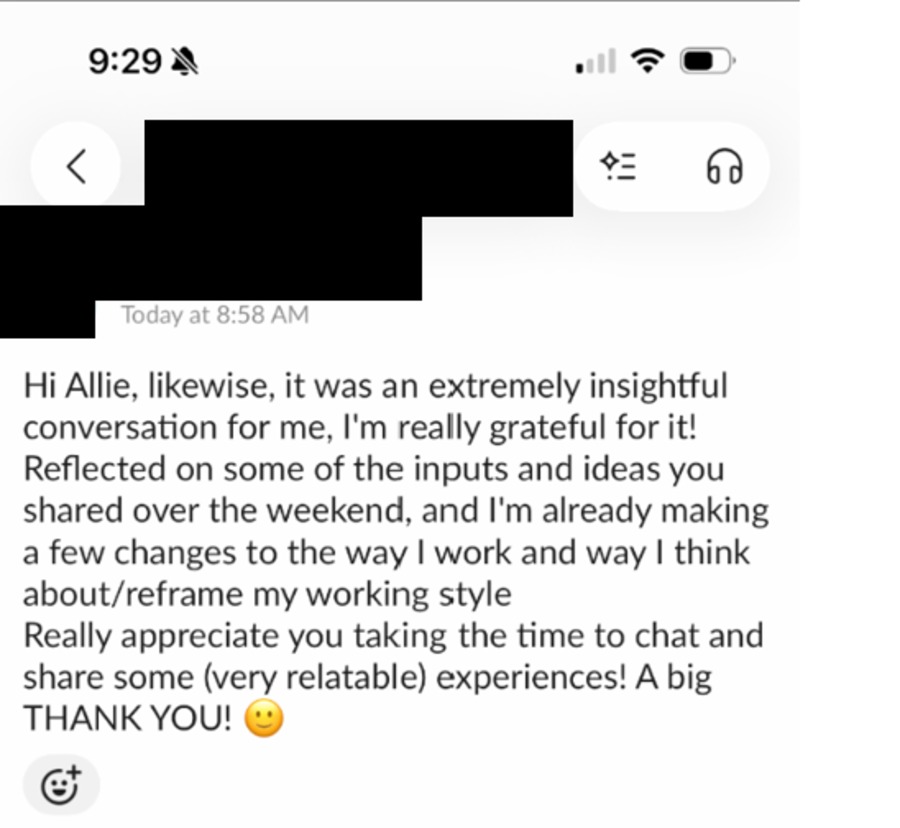
Message describing an insightful conversation and changes already being made to how she works.
Changing how she works

Work with me.

The Recalibrated Return — Founding Cohort

Full · waitlist open

A four-week small-group program for women in their first year back from maternity leave. We apply all four pillars — Notice, Inspect, Rewrite and Reality — to the way they're actually working.

Join the waitlist

1:1 Advisory

Booking from September

For women who want to apply the method to their own situation — their role, team, organization, constraints and life outside work. I'll open a small number of 1:1 spots from September.

The next cohort.

The founding cohort is running now with ten women. Join the waitlist and I'll send you the dates and details when the next cohort opens.